GOVERNANCE, SECURITY & #CYBERPOLYCRISIS
A world of pain: PowerSchool and the cyberpolycrisis
Data breach laws, offshore access, acquisitions, SOC 2 compliance theater, and the next wave of AI risk.
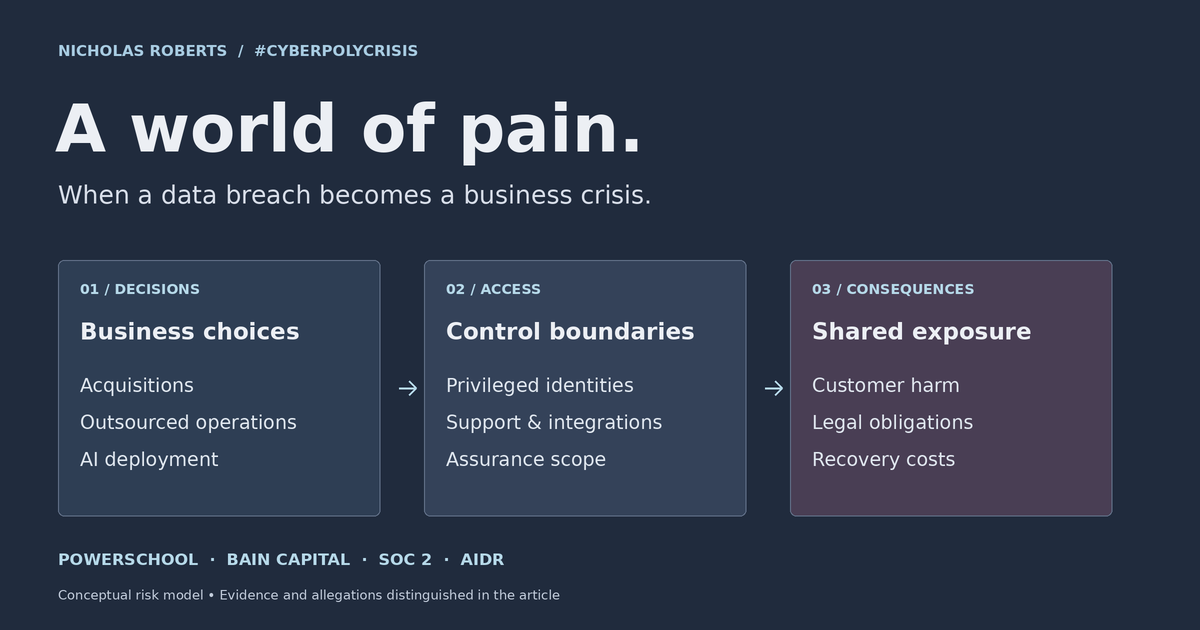
A breach can turn a technology company’s growth story into years of investigation, litigation, customer support, and expensive reconstruction of trust. The people whose information escaped may carry the consequences much longer.
PowerSchool is a particularly sharp example because the records concern children, families, and educators. The business lesson reaches well beyond education: acquisition decisions, outsourced operations, assurance reports, and production access belong in the same risk discussion.
Add AI systems that can read sensitive information and act across applications, and the question becomes urgent. Who can reach the data, who approved that access, and what evidence shows that the boundary holds?
01 / THE DOCUMENTED RECORD
The breach outlived the incident response.
Bain Capital announced a transaction valuing PowerSchool at $5.6 billion in June 2024. PowerSchool’s SEC filing records the merger closing on 1 October 2024, through entities affiliated with Bain-advised funds. Those dates establish the ownership timeline; they do not, by themselves, establish responsibility for a breach. Bain announcement · SEC closing filing.
Newfoundland and Labrador’s government records that PowerSchool became aware of the incident on 28 December 2024 and notified the province on 7 January 2025. Its account also records subsequent extortion attempts against school districts in May 2025 using stolen data, despite an earlier ransom payment and assurances of deletion. Paying for a promise did not make the copied information disappear. Provincial incident timeline and follow-up.
A May 2026 report from Newfoundland and Labrador’s privacy commissioner identified 285,158 affected individuals in that province, including records relating to former students dating back to 1995. Drawing on investigations in Ontario and Alberta, it described compromised privileged subcontractor credentials, missing multifactor authentication on PowerSource, limited logging, and insufficient restrictions on remote support. That is a provincial count, not a worldwide total. Report P-2026-001, pp. 3 and 17–19.
The same report records remediation, including deactivating the compromised credential, resetting passwords, tightening portal access, and requiring access through a VPN using single sign-on and MFA. Those actions matter. They also illustrate the difference between stopping further access and recovering confidentiality after information has been copied. Containment findings, pp. 38–39.
02 / ACQUISITIONS & ACCOUNTABILITY
The operating plan belongs in the diligence file.
In March 2026, a federal court allowed several claims against Bain to proceed, including negligence, while dismissing others, including the CCPA claim against Bain. The complaint alleged that Bain influenced cost reductions, workforce changes, and offshore operations in ways that weakened protection. The court assessed whether those allegations were sufficient at the pleading stage. It did not decide that Bain caused the breach or was liable for damages. March 18 order, especially pp. 2–3 and 28–29.
In July, the court denied Bain’s request for reconsideration and certification of an interlocutory appeal. Its analysis again addressed the sufficiency of specific allegations about control and conduct. Bain disputed the legal basis for those theories. These procedural rulings should not be presented as a final verdict. July 27 order.
My management conclusion is straightforward: an acquisition model should price the security consequences of the proposed operating model. A plan to consolidate support, replace teams, integrate identities, or accelerate releases changes how the business protects its customers.
Before approving the savings, ask what happens to privileged access reviews, incident response coverage, system knowledge, and recovery capability. Fund the transition controls. Assign someone authority to stop an integration that exposes customer records. Record who accepted unresolved risks and the date by which they must be reduced.
A lower operating expense is only part of the calculation. A useful investment case also shows the cost of safely delivering that reduction.
03 / OFFSHORE ACCESS
Follow the permissions across the border.
Offshore delivery can provide excellent engineering and support. Geography is a poor substitute for examining the control design. A domestic contractor with permanent administrator access can be more dangerous than an overseas team working through tightly constrained, monitored sessions.
Assess three things separately: where data is stored, where people can access it, and which organization controls their access. A domestic hosting region does not answer all three questions. Neither does a contract saying the supplier is responsible for security.
For each support provider, require named identities, strong authentication, access limited to the customer and task, expiry, useful audit records, and a tested revocation process. Establish which subcontractors can participate and how a change is approved. A support ticket should not silently become permission to browse every tenant.
Cross-border access can also create legal obligations. Australia’s privacy regulator explains that APP 8 and section 16C can leave a covered Australian entity accountable for an overseas recipient’s handling of disclosed information, subject to the framework’s conditions and exceptions. GDPR processor and international-transfer requirements need separate assessment where they apply. OAIC cross-border guidance · GDPR Articles 28 and 44–49.
04 / SOC 2 COMPLIANCE THEATER
Read the scope before trusting the badge.
The most instructive detail in Alberta’s PowerSchool investigation is an assurance gap. The regulator reviewed a SOC 2 Type 2 report and a penetration-test report. PowerSource was outside the scope of both. The report explains that the excluded portal provided a path into student information systems and should have been included in the security assessments. Alberta investigation, paragraphs 130–138.
PowerSchool’s response, reproduced in the investigation, pointed to assessments of its core products and said it was implementing additional safeguards. The regulator’s finding was about a material access path left outside the assessments. It is not evidence that every control was untested or every auditor acted improperly. PowerSchool response and scope analysis, paragraphs 131–137.
SOC 2 can provide useful assurance about specified controls. AICPA describes SOC reports as information for assessing outsourcing risk. Treating the report as evidence requires reading it; treating a logo as proof that the entire business is secure skips that work. AICPA’s SOC overview.
That substitution is what I mean by compliance theater: the appearance of assurance doing the job of an actual risk decision. My criticism is aimed at how evidence is selected and used, rather than at the existence of independent assurance.
- Boundary: does the report include support portals, administrative tooling, integrations, and relevant subcontractors?
- Time: what period was assessed, and what changed after it?
- Exceptions: which controls failed, and has remediation been demonstrated?
- Your obligations: which controls must the customer operate for the overall arrangement to work?
- Proof: can the supplier demonstrate that a support user cannot retrieve an unrelated customer’s records?
05 / DATA BREACH LAWS
One incident can start several clocks.
Notification, reasonable security, privacy, contractual commitments, and consumer protection are different obligations. A team can contain an intrusion and still face difficult questions about what it promised, what it retained, and when it told affected people.
Texas’s original petition against PowerSchool alleges deceptive security representations and failures to protect sensitive information under the state’s Deceptive Trade Practices Act and Identity Theft Enforcement and Protection Act. These are the state’s allegations, not findings of liability. They illustrate why the language in a sales deck, security questionnaire, or customer agreement belongs in a breach review. Texas Attorney General’s petition.
| Obligation | What the response plan needs |
|---|---|
| California notification | SB 446 introduced a 30-calendar-day disclosure requirement from discovery or notification of a breach, subject to permitted delays for law enforcement, determining scope, and restoring system integrity. For notices to more than 500 California residents, a sample must reach the Attorney General within 15 calendar days after consumer notification. Confirm the statutory trigger and exceptions for the incident. Assembly legislative summary · State board legislative report. |
| GDPR notification | Where GDPR applies, a controller generally must notify the supervisory authority without undue delay and, where feasible, within 72 hours of awareness, unless the breach is unlikely to risk people’s rights and freedoms. Processors notify controllers without undue delay; high-risk breaches can also require notice to individuals. Articles 33–34. |
| Customer contracts | Track contractual notice requirements separately. Alberta’s investigation found notification did not meet PowerSchool’s agreed timing, while distinguishing that contractual issue from the applicable statutory position at the time. Paragraphs 139–140. |
Have counsel map the applicable laws, exemptions, contracts, and reporting duties before an incident. Maintain an incident timeline, preserve evidence, and identify who can authorize notices. The specific obligations depend on the organization, the data, the affected people, and the facts; this is operational analysis, not advice on a particular legal matter.
06 / AI VIBE ENTERPRISE SLOP
A convincing demo can conceal an unsafe system.
I use AI vibe enterprise slop to describe software promoted into important business workflows because it looks finished, while its permissions, data handling, failure modes, and ownership remain unresolved. AI-assisted development can be valuable. The failure is accepting apparent completeness as operational readiness.
Imagine a customer-service assistant built quickly against a shared database account. It answers questions impressively. It also searches every customer’s records, retains sensitive prompts indefinitely, and can issue refunds without a policy check outside the model. The interface is polished; the authority behind it is excessive.
This is a hypothetical example, not a claim that AI caused the PowerSchool breach. The connection is architectural: a convenient intermediary can become a broadly privileged route to sensitive records.
OWASP identifies excessive functionality, permissions, and autonomy as causes of excessive agency in LLM applications. Its guidance includes limiting tools, enforcing authorization in downstream systems, and requiring approval for consequential actions. A model instruction cannot carry the entire security boundary. OWASP: Excessive Agency.
Before production, test whether the application refuses cross-customer retrieval, rejects actions beyond the user’s authority, handles hostile material in retrieved documents, and leaves an intelligible audit trail. Give a human owner the ability to revoke the integration and restore the previous workflow.
07 / AI DETECTION & RESPONSE
AIDR needs its own acceptance test.
Here, AIDR means AI Detection and Response: monitoring AI activity, identifying threats, and applying response or policy controls. For example, CrowdStrike’s documentation describes sending AI traffic to AIDR APIs for policy evaluation and logging events for investigation. That describes a capability and integration model, not a guarantee that every deployment will prevent every attack. CrowdStrike AIDR documentation.
Evaluate coverage in the actual workflow. Does the control see browser use, direct API calls, background agents, and tool execution? Can it interrupt a dangerous action before the downstream system commits it? Who receives the alert, and what happens when the inspection service is unavailable?
Inspection introduces another data-handling decision. The same documentation distinguishes roles that see metadata from roles that can see full prompt content and sensitive values. Review the collection, redaction, retention, residency, and access arrangements for that telemetry. Security tooling can itself become a repository of sensitive business information. AIDR role and data-access documentation.
Require a controlled demonstration: a hostile instruction enters a document; an agent attempts an unauthorized export; the destination system refuses it; the monitoring layer records enough evidence for investigation. Include a legitimate task to check that normal work still succeeds.
Otherwise, AIDR risks becoming the next reassurance badge in the procurement form. Buying a tool should start an operating practice, with ownership, coverage checks, and response exercises.
08 / THE BUSINESS RESPONSE
Own the downside before scaling the upside.
This is the #cyberpolycrisis connection: business decisions change access; access connects organizations and systems; a compromise then creates simultaneous technical, legal, financial, and human demands. Those demands compete for the same people who must keep the business running.
The costs can include forensic work, legal advice, notification, customer support, remediation, interrupted projects, insurance friction, and lost renewals. Which costs materialize depends on the event. For affected families, the burden also includes uncertainty and time spent protecting identities—costs that do not appear in the supplier’s recovery dashboard.
- Business owners and acquisition teams: require a costed security transition plan alongside the growth and savings plan. Review the decisions that could widen access or weaken response capacity.
- Technology managers: map the routes to sensitive records, including support, recovery, integrations, and AI tools. Compare that map with the actual assurance scope.
- Engineers: enforce permissions where actions happen, separate customer access, expire delegated privileges, and test revocation. Treat AI-generated changes as production code requiring review.
- Customer-service teams: prepare clear, approved explanations of what is known, what is uncertain, and how people can get help. Preserve a human escalation route.
- Customers and procurement teams: ask for evidence covering your workflow. Put notification, access changes, data return, and deletion requirements into the relationship before renewal.
A growing business does not need an impressive stack of assurances. It needs justified confidence in its ability to protect people, explain its decisions, contain a failure, and keep its commitments. PowerSchool’s breach and the litigation involving Bain make the cost of confusing those two things unusually visible.
That is the world of pain to avoid: growth built on access and obligations that nobody fully owns.
Evidence reviewed on 23 October 2026. Links distinguish company statements, regulatory investigations, legislation, and court rulings. Litigation allegations are attributed; the management recommendations, hypothetical AI example, and “compliance theater” framing are the author’s analysis. This article does not report a final liability judgment against Bain.