THINKING OUT LOUD
Pascal's AI Wager
Why small businesses should skip both AI sermons, and what to bet on instead
In this article
Two sermons, one congregation
If you run a small business right now, you are sitting in a church with two preachers. Neither one is talking to you.
The first preacher is the doomer. He stands at the pulpit and warns that the machines are coming, that the end is near, that we must repent and pause the training runs. His sermon is about civilization, extinction and the fate of the species.
The second preacher is the evangelist. She promises paradise by next quarter. Ten times the productivity, half the headcount, and an AI agent that runs your whole back office while you sleep.
I've spent 25 years shipping technology in ecommerce, fintech, telecom and civic tech. Most recently I ran technology and operations for a wine ecommerce business. I've watched a lot of small and mid-sized companies try to decide what to do about AI, and almost all of them freeze between these two sermons.
This post is about getting out of the pew. To do it, I want to borrow an argument from a 17th-century French mathematician who thought very hard about betting on things you can't be sure of.
Where the fire and brimstone comparison is fair
Critics like to say AI doomerism is just a revival tent with better slides. They're not entirely wrong.
The story has the same shape. There's an approaching end, a small group who can see it coming, and a closing window to act. That's classic apocalyptic structure. Humans have found it compelling for thousands of years, whether or not the end ever arrived.
Infinite stakes swamp ordinary reasoning. When the downside is extinction, any probability looks big enough to justify anything. Hold that thought, because it's exactly the move Pascal made.
There's a call to repent. "Turn from sin" becomes "pause the training runs." Both ask you to give up something you want now to avoid something terrible later.
There's a congregation. AI risk culture has its own vocabulary, its own prophets and its own scripture-length blog posts. Like any tight community, it rewards members for believing harder.
Missed dates don't end the faith. Preachers re-date the Rapture. Some AI forecasters have quietly pushed their timelines back without changing their underlying view.
Where the comparison breaks down
It's a fun comparison. It's also lazy if you stop there.
Revelation vs. evidence. The preacher's authority comes from scripture. AI risk arguments point at things you can check: models pursuing goals in ways nobody intended, systems gaming their own evaluations, and capabilities growing faster than our ability to see inside them. You can argue about how much those findings matter, but they're findings, not articles of faith.
The prophets are building the thing. No hellfire preacher ever ran a demon-summoning startup. A lot of the people worried about AI work at the labs building it. Cynics read that as marketing. Either way, it's not how religious movements usually work.
The experts take it seriously. Turing Award winners, government safety institutes and many working researchers treat serious AI risk as a real question. Fire and brimstone never got that kind of buy-in from people who actually understood the subject.
The fixes are boring. Most proposed fixes are testing, transparency, oversight and liability rules. That's the toolkit we use for aviation, nuclear power and food safety, not an altar call.
So the honest view is this: the preacher comparison tells you about how people believe, not about what's true. Apocalyptic psychology can grab onto real risks as easily as imaginary ones. Cold War nuclear anxiety had plenty of doomsday-cult energy, and the bombs were still real.
Enter Blaise Pascal
Blaise Pascal lived from 1623 to 1662. He built one of the first mechanical calculators, helped found probability theory, and then, after a religious experience, turned that math on God.
His argument, now called Pascal's Wager, goes like this. You can't prove God exists, and you can't prove God doesn't. So treat it as a bet.
- If you believe and God exists, you win infinite reward.
- If you believe and God doesn't exist, you lose a little: some Sunday mornings and a few pleasures.
- If you don't believe and God exists, you lose infinitely.
- If you don't believe and God doesn't exist, you gain a little.
With infinite stakes on one side, Pascal said, the rational bet is obvious.
Philosophers have been arguing with this for 350 years. The sharpest modern objection has a great name: Pascal's mugging. A stranger says, "Give me your wallet, or I'll use my magic powers to torture a trillion people." The odds he's telling the truth are absurdly small, but multiply them by a big enough number and the math says hand over the wallet.
That's the pressure point in some AI doomer arguments too. If extinction is on the table, even a tiny probability can be used to justify almost anything. When you hear "even a 1% chance justifies...", you're hearing Pascal.
But Pascal's actual method, laying out every combination of choice and outcome and asking what each one costs you, is a really good tool. It just works better when the stakes are real, finite and yours.
Rerunning the wager for a small business
So let's run Pascal's method on the bet in front of you. You don't know whether AI will turn out to be genuinely useful for your business or mostly hype. That's the uncertainty, the equivalent of "does God exist?"
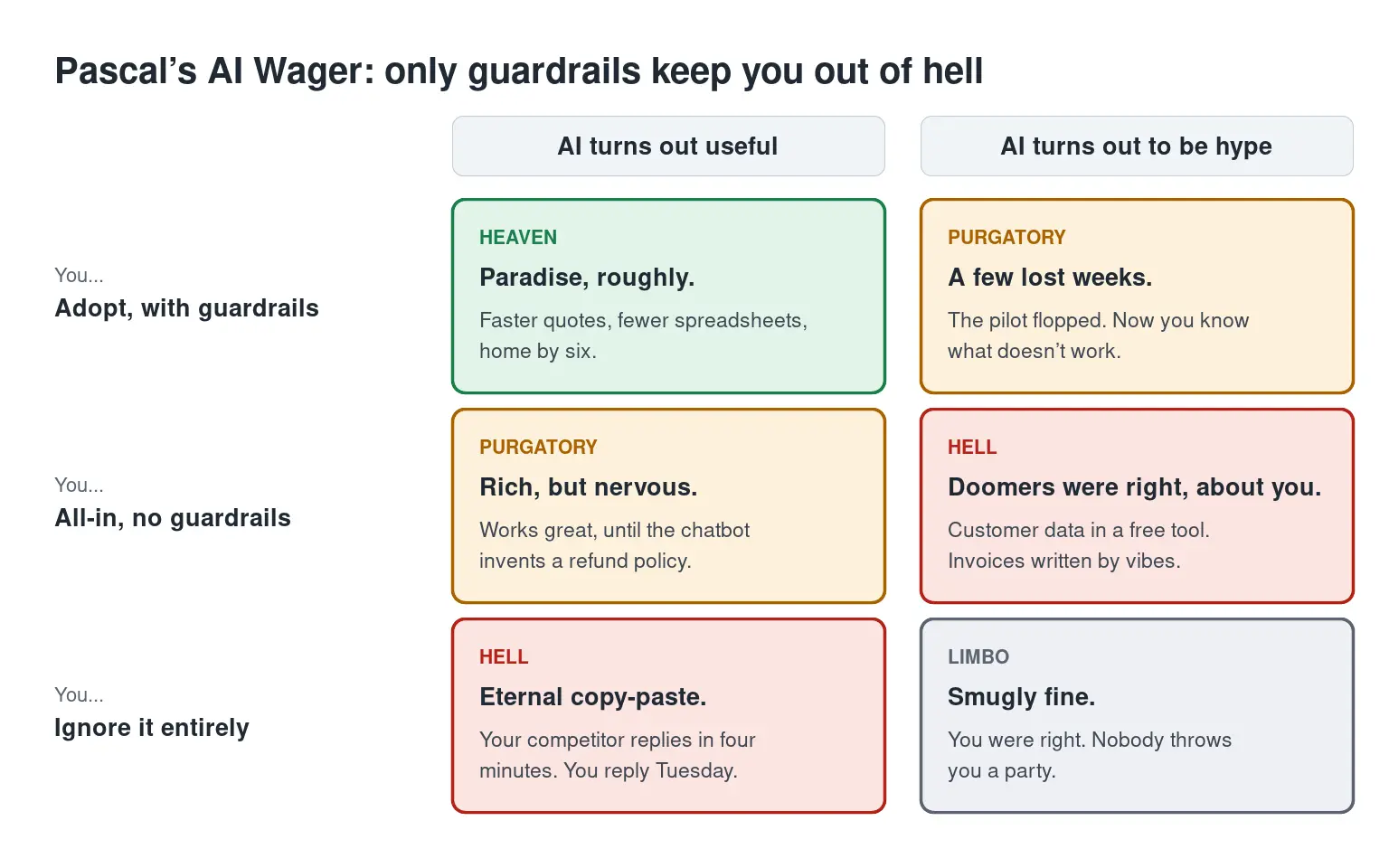
But Pascal only gave himself two choices, believe or don't. You have at least three: adopt AI with guardrails, go all-in without them, or ignore it entirely. Here's what each choice gets you under each outcome.
| You... | AI turns out useful | AI turns out to be hype |
|---|---|---|
| Adopt, with guardrails | HeavenParadise, roughly. Faster quotes, fewer spreadsheets, home by six. | PurgatoryA few lost weeks. The pilot flopped. Now you know what doesn't work. |
| All-in, no guardrails | PurgatoryRich, but nervous. Works great, until the chatbot invents a refund policy. | HellDoomers were right, about you. Customer data in a free tool. Invoices written by vibes. |
| Ignore it entirely | HellEternal copy-paste. Your competitor replies in four minutes. You reply Tuesday. | LimboSmugly fine. You were right. Nobody throws you a party. |
Read it by row, not by column. The "guardrails" row is the only one with no hell in it. If AI is useful, you win. If it's hype, you've lost a few weeks and learned something.
The other two rows each hide a hell, just in different columns. Going all-in punishes you when the hype is real but messy, because the same speed that helps you also spreads your mistakes. Ignoring AI punishes you when it works, because your competitors get faster and you don't.
The twist: the worst outcomes have almost nothing to do with whether the doomers or the evangelists are right. They depend on what you do. That's what makes this a much better wager than Pascal's. The stakes are finite, the outcomes are visible, and you can change your bet next quarter.
The risks that actually matter are boring
Here's the part neither preacher talks about. For a 10, 50 or 200-person company, AI risk isn't existential. It's operational, and it looks like this:
- Confident wrong answers. A support bot tells a customer something that isn't your policy. Courts and tribunals have already held companies responsible for what their chatbots promised. Your bot speaks for you.
- Data in the wrong place. An employee pastes a customer list, a contract or source code into a free consumer AI tool to "just clean it up." Now it's on someone else's servers under someone else's terms.
- Automating what nobody understands. You automate a messy process. It runs fine for three months. Then it breaks quietly, and nobody left on the team knows how it was supposed to work.
- Getting locked in. You rebuild your workflows around one vendor's tool, and then the pricing, the model or the terms change underneath you.
- Review that slowly disappears. "The AI usually gets it right" is how human review dies. First people skim, then they stop checking.
None of these will end civilization. Every one of them can cost you money, customers or trust, and in a small business those are the things that end you.
Guardrails in practice: a short playbook
Guardrails sound like enterprise overhead. They aren't. For a small business they fit on one page, and you can set them up in a week.
- Pick one workflow. Not "AI strategy." One workflow with a clear owner and a measurable result, like drafting first-pass quote responses, tagging support tickets or summarizing supplier emails.
- Write down what the AI may touch. Which data it can see, which tools it can use, and which it can't. Customer payment data, HR files and contracts usually go on the "no" list until you have a business-grade tool with real data terms.
- Keep a human on anything customer-facing. If it goes to a customer, a regulator or a bank, a person reads it first. You can relax this later, once the numbers say you can.
- Measure before you scale. Time saved, error rate and customer complaints, compared against how things worked before. If you can't measure it, you can't defend it, to your team or to yourself.
- Plan your exit. Keep your prompts, data and process docs portable. Ask "what happens if this vendor doubles its price?" before you have to answer it.
- Review monthly. Fifteen minutes: what worked, what broke, what you'd add or pull back. Rules should change as the tools change.
That's it. No ethics board, no 40-page policy. Just the difference between a pilot and a gamble.
The real wager
Pascal thought the only question was whether to believe. For small businesses, AI has become a belief question too: you're either a believer or a skeptic, a doomer or an accelerationist.
But run the matrix and the question changes. The outcome that matters most isn't whether AI lives up to the hype. It's whether you put guardrails on it. Guardrails make AI's upside safe to take and its downside cheap to survive.
The doomers may or may not be right about civilization. You don't need to settle that to run your business well this quarter. Skip both sermons, start one pilot, and keep a human in the loop.
Pascal would take that bet. I think you should too.
Which square of the matrix is your business in right now? And what's the one AI rule your team actually follows? Email me at [email protected] or reply on LinkedIn. I read every one.
Written by Nicholas Roberts.