LEADERSHIP
Startup to Scale-Up: Lessons from Wine Ecommerce
How to keep startup speed while you build the systems you need to scale
In this article
The stretch where companies stall
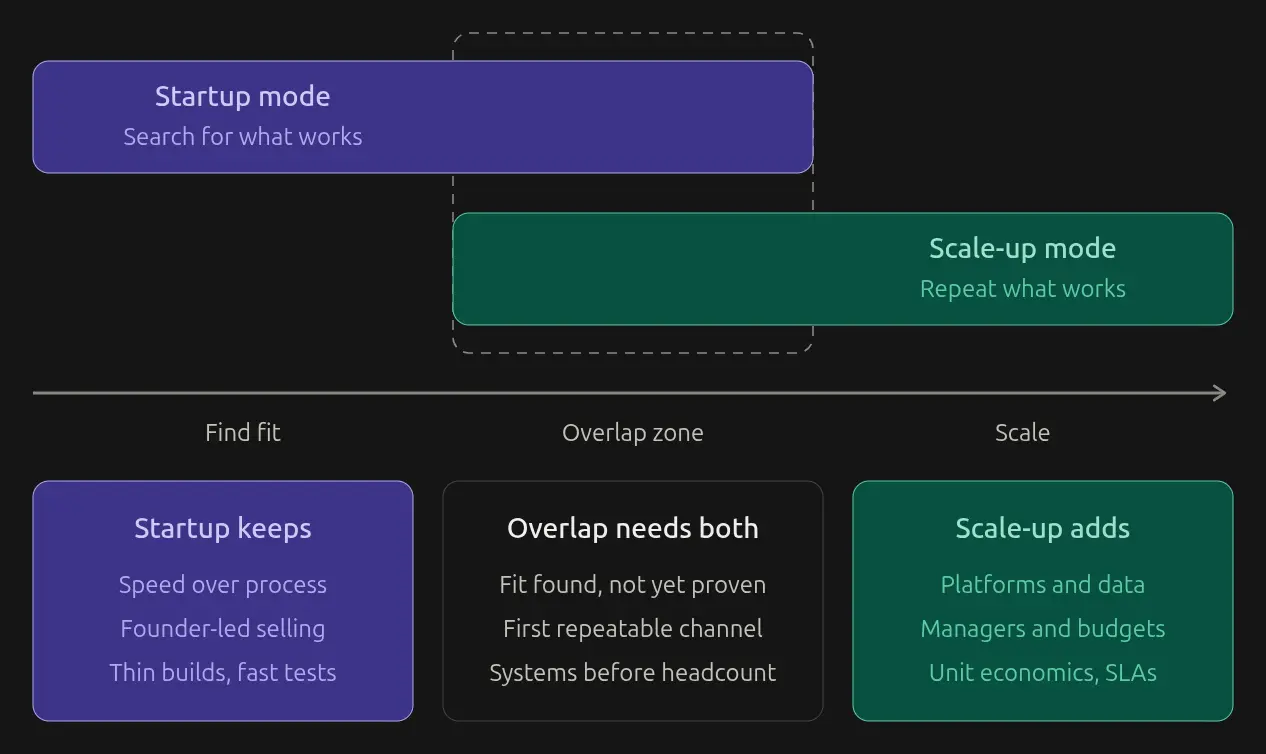
Every growing company passes through an overlap. It has found something that works, but that thing is not yet repeatable. Startup mode searches for what works. Scale-up mode repeats it. For a while, the company has to do both at once.
This is where many companies stall. If they bring in scale-up process too early, they lose the speed that got them there. If they run on founder energy too long, the business starts to break as volume grows. Fulfillment slips, support queues grow, the data stops agreeing with itself, and margins get thin without anyone noticing.
The leaders who do well here can still ship fast while they build the platforms, metrics and team structure that the next stage needs. I recently spent almost two years in that overlap at a multi-brand wine ecommerce group. This article explains what that work looked like, and why I think it is the work I do best.
What the overlap looked like in wine ecommerce
The core business sold wine in high-velocity daily and flash sales. That model rewards speed and volume. Each offer goes live, sells, and the warehouse has to ship what was sold. Around it, the group grew into a portfolio of ecommerce brands, from sparkling wine to a tasting room and non-alcoholic drinks.
When I joined, the business had a model that clearly worked. It also had a legacy commerce platform that carried most of the group's revenue. The business ran many different sales models: flash sales, a shoppable store, daily drops, private sales, auctions, club subscription boxes and chat commerce. Its catalog had tens of thousands of SKUs.
That is a startup that has won, and now has to become a company that can repeat the win. I started as Ecommerce Systems Administrator. Within months, I became Director of Technology & Operations.
Keep the startup speed
The first rule of the overlap is to protect the thing that works. For this business, that was the daily rhythm of offers and orders. Nothing I built was allowed to stop it.
We changed platforms without a pause in trade. We moved the legacy site to Shopify Plus and a cloud warehouse management system while the business kept selling. I wrote the Python and Pandas migration workflows myself, and they moved millions of historical orders, together with customer and product data.
We kept builds thin and tests fast. We made Shopify Plus launches and React Native ecommerce apps. I managed each one from discovery through launch readiness and adoption.
I stayed hands-on. I built prototype internal tools for integrations, workflows, dashboards and operational health with Claude Enterprise, Python, FastAPI and Supabase. In the overlap, a leader who can still build removes weeks of waiting for a vendor.
Build the systems before the headcount
The second rule is to build systems before you hire people to work around missing systems. Each new person who copies data between two tools is a cost that grows with volume.
One catalog for every sales model. We supported all the sales models from one catalog data model. A new offer type did not need a new copy of the product data.
Data the whole company can use. We connected the finance ERP and enterprise analytics platforms to the commerce data. Claude and Jupyter let me turn those numbers into decisions with the data, growth and marketing teams.
Corporate IT that scales. I operated the workplace suites, analytics platforms and a company-wide IT help desk. I also led the company-wide Claude Enterprise rollout, with governance and support. The group reported strong double-digit top-line growth in this period. I supported that growth; I do not claim it as mine alone.
Build the team structure
The third rule is that a scale-up needs managers and owners, not only heroes. Founder energy does not divide well across a portfolio of brands.
I hired and onboarded managers, administrators and future executives, and built a team of direct reports. I managed several vendor teams for web, app, middleware and customizations, across time zones.
I also worked across functions every day: the warehouse, growth, data, marketing and customer teams. In the overlap, most problems sit between teams, not inside one team. The person who can talk to all of them, and also read the code, can find the real cause quickly.
Why this is the stage I fit
This was not the first time I worked in this overlap. My career has moved through both modes many times.
- Zero to one. At Mantra Resorts, I owned the full delivery for a new hotel chain's ecommerce, across several large sites. At Sonic, I became the company's first technical project manager.
- Operations at scale. At Section.io, I took follow-the-sun on-call for Toyota, BoxyCharm, Universal Music Group and many other ecommerce businesses, with DDoS, WAF and bot incidents.
- Revenue and teams. At Datava, I led an engineering team in professional services for banks and credit unions.
- Building now. In a recent AI builder sprint, I built several AI products with Claude, Cloudflare Workers, Postgres and Pydantic AI.
That mix is what the overlap needs. I can still ship like a startup, and I know what a scale-up must have in place before volume arrives: platforms, data, owners and budgets.
What I am looking for
I want a hands-on VP, CTO or Director role in a company that has found what works and now has to repeat it. If your team is in the overlap zone, I would like to hear what is about to break first.